

Refashion and Ecomodulation | Testing for Bonuses
There are more pathways to a Refashion bonus beyond durability testing. To earn your maximum bonus from Refashion, it’s essential you understand the other Refashion bonus pathways, avoid potential penalties, and receive support from a team well-connected to Refashion and who has enabled other brands and retailers to earn bonuses since the beginning.

There are more pathways to a Refashion bonus beyond durability testing. To earn your maximum bonus from Refashion, it’s essential you understand the other Refashion bonus pathways, avoid potential penalties, and receive support from a team well-connected to Refashion and who has enabled other brands and retailers to earn bonuses since the beginning.
The full picture of Refashion bonuses and what could block them
Refashion is an ecomodulation framework in France for clothing, household linens, and footwear. It incentivises companies putting products on the French market to meet France’s Extended Producer Responsibility (EPR) obligations by qualifying for money back in the form of bonuses. To be eligible for a bonus, a brand or retailer will need to demonstrate that a product reference meets criteria via testing and evidence. Therefore testing becomes not just a compliance expense, but it can allow a business to qualify for a Refashion bonus and recover money.
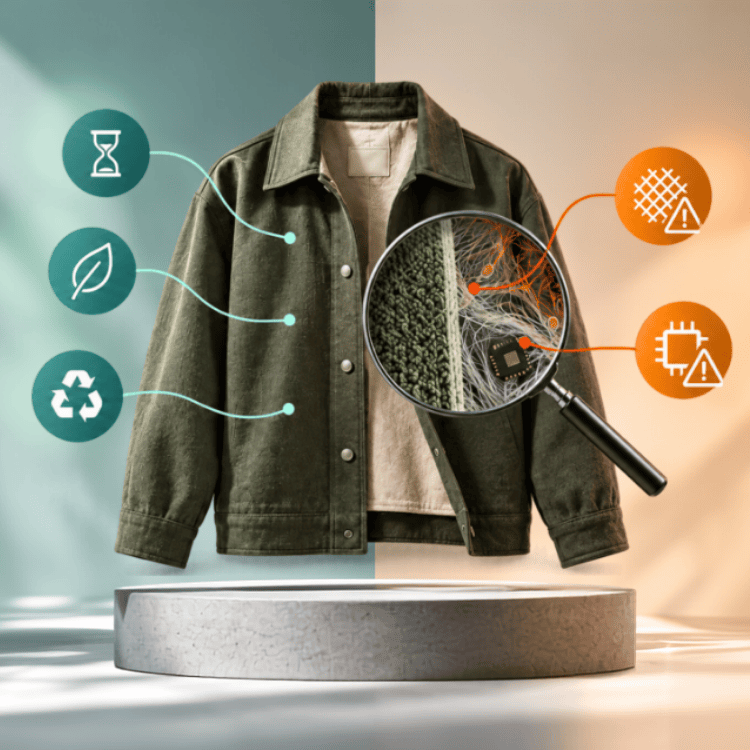
There are 3 ways to earn a Refashion bonus: durability, environmental certification, and recycled raw materials. These bonuses can stack on the same product reference, but each must be supported by its own pre-declaration. There are also two ways that block any Refashion bonus: penalties from metalloplastic fibres and embedded electronics.
One penalty. No bonus. No exceptions
Avoiding penalties is just as important as pursuing bonuses. A product subject to a penalty cannot receive a bonus. It removes bonus eligibility for a product reference entirely.
The durability Refashion bonus
The Refashion durability programme covers 11 categories, including tops, bottoms, intimates, socks, outerwear, bath linen, bed linen, table linen, and 3 footwear categories.
It includes some particularly important distinctions:
- Knitted vs woven products: Refashion’s dimensional-stability criteria distinguish between knit and woven constructions.
- Swimwear is treated differently: Refashion for swimwear introduces criteria that are not normally relevant for apparel.
- Socks have abrasion requirements: Refashion assessments target the heel and sole, with specific distinctions on the intended use of the product (i.e., everyday use versus athletic).
- Intimates have construction-specific tests: Refashion criteria include bursting strength, seam slippage, and elasticity.
- Bed linen is washing or abrasion focused: Refashion framework emphasises dimensional stability after washing, Martindale abrasion, appearance after washing, and colour fastness.
The role of testing to turn durability into evidence
With Refashion-aligned durability testing and evidence from an accredited laboratory, such as Eurofins, the bonus pathway is supported. Brands and retailers should select references using a risk-based and volume-based approach rather than a purely random or pass-oriented selection. Our dedicated Refashion experts recommend balancing business impact, product representativeness, technical risk, and likelihood of passing the required criteria.
How we help businesses fulfill the durability Refashion bonus
Our role is not limited to performing durability tests. We help brands and retailers build an efficient, risk-based reference selection strategy, identify potential weaknesses before testing, perform the complete durability assessment, analyse failures, and support corrective actions. This enables our customers to optimise their testing investment while building robust evidence for the Refashion durability bonus.
View our durability testing capabilities here.
We have been helping brands and retailers earn the Refashion durability bonus since the beginning. Contact us to receive dedicated support and earn your Refashion bonus.
The environmental certification and recycled raw materials Refashion bonus
Whether an environmental certification supports a Refashion bonus depends on the certification held and how it applies to the product reference. According to Refashion, to be eligible for an environmental certification bonus, the finished product must be certified by a Global Certification Programme. The critical distinction is that the finished product must be certified. Additionally, environmental certification label bonuses are not cumulative.
The recycled raw materials Refashion bonus rewards brands and retailers who incorporate eligible raw materials into products. An important distinction is that Refashion clarifies that recycled material has to come from an eligible waste stream and satisfy specific traceability and recycling-chain conditions. This involves two routes:
- TLC post-consumer: Recycled material from post-consumer textile, clothing, linen, or footwear waste collected or supported by an approved eco-organisation
- Open-loop recycling: Recycled material from another eligible waste stream collected or supported by an approved eco-organisation, excluding food-grade plastic resin
Every bonus claim needs evidence
For the environmental certification Refashion bonus, businesses should be thinking in terms of an evidence chain, not simply having a certificate. Refashion requires the finished product to be covered by a recognised label, with documentation allowing the reference to be linked to the certification.
For the recycled raw materials Refashion bonus, businesses should be able to demonstrate evidence around 5 proof areas.
- Recycled-content declaration
- Origin of the waste
- Recycling-chain traceability
- Recycling facility evidence
- Finished product linkage
The key is to demonstrate not only that a finished product contains recycled materials, but that the recycled feedstock itself is eligible and traceable through the required recycling chain.
How we support earning environmental certification and recycled raw materials Refashion bonuses
The pathways to these bonuses are more complex than durability. We offer the relevant environmental certifications and help brands verify eligibility of recycled feedstock, assess the recycling chain, trace the recycled material into finish products, and quantify the potential Refashion bonus.
What can block a Refashion bonus?
A product subject to a penalty cannot receive a bonus, and the Refashion penalties are related to the use of metalloplastic fibres and embedded electronics in a product. Risks of these penalties can be present at a product level, testing or certification level, within supply chain traceability, quantification, and documentation.
The issue is not simply the cost of the penalty itself, but also the loss of any eligibility for applicable ecomodulation bonuses. Because of this, our Refashion experts recommend checking for penalties before you pursue bonuses.
How we help businesses avoid penalties
We help brands and retailers identify penalty risks early, before products are finalised or declared:
- BOM & product review
- Component screening
- Supplier documentation review
- Design-stage support
- Portfolio screening
- Bonus/penalty optimisation
Why top brands and retailers rely on Eurofins Sustainability Services for Refashion support?
Eurofins Sustainability Services offers a variety of unique advantages for businesses looking to maximise the Refashion bonuses they earn.
- Refashion expertise: Our dedicated experts stay connected to Refashion requirements and have been supporting businesses with this since the beginning.
- One partner across multiple pathways: Support covering durability, environmental labels, recycled materials, and penalty-risk assessment.
- Technical + sustainability expertise: Combine product testing, material knowledge, certification review and sustainability requirements.
- Portfolio-level approach: Assess references strategically rather than treating each product in isolation.
- Evidence & documentation support: Help brands identify gaps and organise the information needed to substantiate eligibility.
- Supply-chain perspective: Review relevant supplier and material information to strengthen traceability and data quality.
- Risk-based prioritisation: Identify potential bonus opportunities and penalty exposure early, helping brands focus resources where they matter most.
- From assessment to action: Translate findings into practical recommendations, testing plans and corrective actions.
We combine technical expertise, sustainability knowledge, and portfolio-level analysis to help brands navigate Refashion requirements, make informed product decisions, and maximise bonuses. Contact us to get started.
All services
Our services
Why Eurofins Sustainability Services?

We are a leader in providing sustainability metrics and measurements in the form of testing, audits and analysis across a variety of business sectors.

We have expertise across sectors that includes food, agriculture, environment, materials, engineering, life sciences, construction, electronics, consumer products, cosmetics, packaging, clothing and footwear.

Our sustainability services are offered globally through our team of around 63,000 employees working out of more than 950 laboratories in over 1,000 companies and 60 countries